
Knowledge Currency: Wikipedia, Musk’s Billion Dollar Offer, and the #BetterSharing Revolution
By: Elizabeth Spica
Last month, Elon Musk offered to give Wikipedia one billion dollars if it changed its name to a rather unflattering alternative.[1] Wikipedia, the free internet encyclopedia, is one of over a dozen “free knowledge projects” safeguarded by the Wikimedia Foundation, a 100% donation-driven nonprofit employing hundreds and supported by hundreds of thousands of volunteers worldwide.[2]
Why would Elon Musk—the man who desires to enable the survival of humanity, to combat climate change, to alleviate urban congestion, and to address neurological conditions through technologies that enhance human cognitive abilities—not also share in Wikimedia Foundation’s mission “to empower and engage people around the world to collect and develop educational content under a free license or in the public domain, and to disseminate it effectively and globally”?[3] Musk is likely not proud of some of the content in his own entry, yet in the absence of that content being speculative, inaccurate, or otherwise inappropriate, that content will not be removed.[4]
Musk’s Wikipedia entry, like all others, was curated and verified by a diverse range of contributors, with facts presented from a neutral point of view and citations from trusted, verifiable sources.[5] For example, scattered amongst sections regarding his business accomplishments and personal life are also mentions of his COVID-19 conspiracy theories and his tweeting a link to unfounded, homophobic allegations about the violent attack on Nancy Pelosi’s husband (citing to articles from Vox and NPR, respectively).
While it’s understandable that Musk would prefer these lamentable moves be redacted from his entry, if he better understood the importance of Wikipedia, he probably would not have made his lurid name change offer. After all, access to information is recognized as a fundamental human right.
Article 19 of the Universal Declaration of Human Rights emphasizes that everyone has the right to freedom of expression, including the freedom to “seek, receive and impart information and ideas through any media and regardless of frontiers.” [6] By making content available in multiple languages, Wikipedia transcends borders, democratizes information, and serves as an efficient resource for people seeking, receiving, and imparting information.[7]
Wikipedia furthers the fundamental human right of expression and access to information by making content freely available for reuse, using licenses available through Creative Commons (“CC”), an international nonprofit dedicated to building and sustaining “a thriving commons of shared knowledge and culture.”[8] Under a traditional copyright, which begins in most countries when a creation is fixed in tangible form, the author maintains an exclusive monopoly over aspects like reproduction, derivative works, and public display. In contrast, when an author applies a Creative Commons license to their work, they still have protection under copyright law but also the freedom to choose how they want to let others share and reuse their work, for example, by allowing commercial use or permitting modifications.[9] Creative Commons currently offers six core license options:[10]
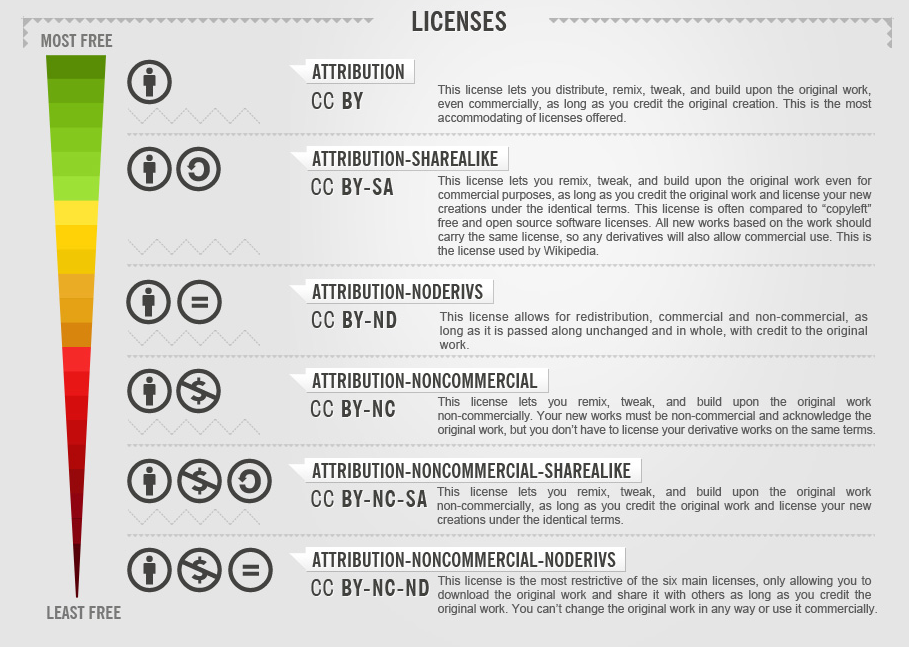
Image: Foter, CC BY-SA 3.0, via Wikimedia Commons
Wikipedia recently adopted the CC BY-SA (“Creative Commons Attribution-ShareAlike”) license for all new content added to their free internet encyclopedia.[11] This license enables reusers of Wikipedia content to freely distribute, remix, adapt, and build upon the material in any medium or format without permission from the author, so long as they (1) give credit to the author and (2) license any new creations under identical CC BY-SA license terms.
The same Creative Commons licenses that empower anyone across the globe to “seek, receive and impart information and ideas” are also being used to lower textbook costs and make information more accessible to students and curious readers alike.[12] For example, many law faculty combine Creative Commons-licensed content with public domain case law to create free casebooks,[13] and faculty across all disciplines contribute to and access Creative Commons-based textbooks through projects like OpenStax, Lumen Learning, and OER Commons.
So, while Musk’s discomfort may stem from the transparency and neutrality maintained in his Wikipedia entry, in the end, his unconventional offer and name change request provides an opportunity to illuminate Wikipedia’s broader significance as a beacon for democratizing information on a global scale. Maybe one day Musk will understand how Wikipedia’s free knowledge mission aligns with many of his own desires to make the world a better place, at which point he will hopefully forego his name change demand and just donate that billion.
Such a donation, by the way, would make for a great addition to his page.
Dr. Elizabeth Spica is a Creative Commons-certified educator and former Wikimedia Foundation Legal Fellow expected to graduate from the UT College of Law in May 2024. With interests in copyright, trademark, and consumer protection, she is a free knowledge advocate and aspiring WikiGnome who contributes to the free internet encyclopedia under the username Offensein.
[1] @elonmusk, X (Oct. 22, 2023, 10:41AM), https://twitter.com/elonmusk/status/1716102436123783175.
[2] Support Wikipedia, Wikimedia Found., https://wikimediafoundation.org/support/ (last visited Nov. 7, 2023). See also Tiago Bianchi, Worldwide Visits to Wikipedia.org from November 2022 to April 2023 (in Billions), Statista, https://www.statista.com/statistics/1259907/wikipedia-website-traffic (last visited Nov. 7, 2023) (identifying Wikipedia’s nearly 4.5 billion unique global visitors in April 2023 alone).
[3] See generally Elon Musk, Wikipedia, https://en.wikipedia.org/wiki/Elon_Musk (last visited Nov. 7, 2023).
[4] Content Removal, Wikipedia, https://en.wikipedia.org/wiki/Wikipedia:Content_removal (last visited Nov. 7, 2023).
[5] Dave Lee, No Wonder Elon Musk is Now Attacking Wikipedia, Wash. Post (Oct. 24, 2023, 12:20 PM), https://www.washingtonpost.com/business/2023/10/24/no-wonder-elon-musk-wants-to-see-wikipedia-taken-down/b30c1c3c-728a-11ee-936d-7a16ee667359_story.html; Elon Musk, Wikipedia, https://en.wikipedia.org/wiki/Elon_Musk (last visited Nov. 7, 2023).
[6] G.A. Res. 217A (III), art. 19 (Dec. 10, 1948). See also G.A. Res. 2200A (XXI), art. 19 (Dec. 16, 1966).
[7] Other Languages, Wikipedia, https://en.wikipedia.org/wiki/Help:Other_languages (last visited Nov. 7, 2023).
[8] About Creative Commons, Creative Commons, https://creativecommons.org/about/ (last visited Nov. 7, 2023).
[9] About CC Licenses, Creative Commons, https://creativecommons.org/share-your-work/cclicenses/ (last visited Nov. 7, 2023).
[10] Id. The six CC licenses have undergone various versions since version 1.0 was introduced in 2002. Also noteworthy is the Creative Commons “CC0” public domain dedication tool that allows creators to bypass the restrictions of copyright term and instead immediately release their creations into the public domain.
[11] Wikipedia Moves to CC 4.0 Licenses, Creative Commons (June 29, 2023), https://creativecommons.org/2023/06/29/wikipedia-moves-to-cc-4-0-licenses/ (last visited Nov. 7, 2023).
[12] Lee, supra, note 5.
[13] See generally H20, opencasebook.org (last visited Nov. 7, 2023) (a project of the Library Innovation Lab at the Harvard Law School Library that “helps law faculty create high quality, open-licensed digital textbooks for free.”).
 tennesseelawreview.org